- 这些是子组件将被渲染的模式。
当父组件重新渲染时,例如更新自身状态等时。
当子组件的 props 重新渲染时。
但实际上,只有渲染 props 时才需要重新渲染子组件。其他一切都是不必要的。
・src/example.js
mport react, { usestate } from "react";
import child from "./child";
import "./example.css";

const example = () => {
  console.log("parent render");
  const [counta, setcounta] = usestate(0);
  const [countb, setcountb] = usestate(0);
  return (
    <div classname="parent">
      <div>
        <h3>parent component</h3>
        <div>
          <button
            onclick={() => {
              setcounta((pre) => pre + 1);
            }}
          >
            button a
          </button>
          <span>update the state of parent component</span>
        </div>
        <div>
          <button
            onclick={() => {
              setcountb((pre) => pre + 1);
            }}
          >
            buton b
          </button>
          <span>update the state of child component</span>
        </div>
      </div>
      <div>
        <p>the count of clicked:{counta}</p>
      </div>
      <child countb={countb} />
    </div>
  );
};

export default example;
・src/child .js

const child = ({ countb }) => {
  console.log("%cchild render", "color: red;");

  return (
    <div classname="child">
      <h2>child component</h2>
      <span>the count of b button cliked:{countb}</span>
    </div>
  );
};

export default child;
- 在这种情况下,当我们按下 a(父组件)按钮时,子组件就会被渲染。虽然没有必要。
・像这样。
・src/child .js(使用备忘录钩子)
import { memo } from "react";

function areEqual(prevProps, nextProps) {
  if (prevProps.countB !== nextProps.countB) {
    return false; // re-rendered
  } else {
    return true; // not-re-rendred
  }
}

const ChildMemo = memo(({ countB }) => {
  console.log("%cChild render", "color: red;");

  return (
    <div className="child">
      <h2>Child component</h2>
      <span>The count of B button cliked:{countB}</span>
    </div>
  );
}, areEqual);

export default ChildMemo;
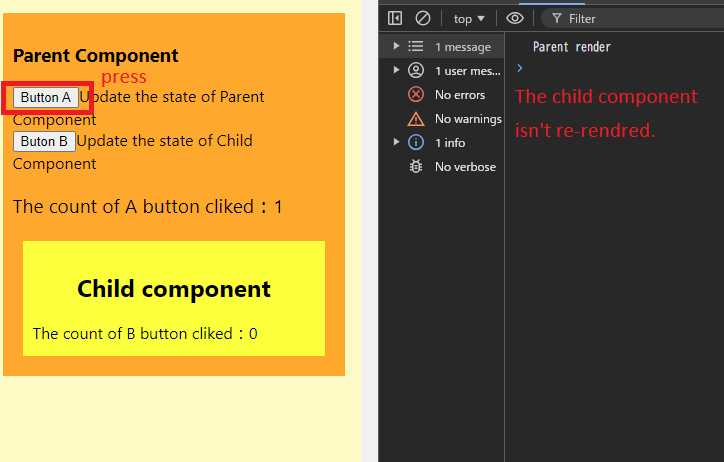
- 如果我们使用memo,我们可以避免不必要的重新渲染。
・像这样。