



vue组件间怎么通讯?下面本篇文章给大家分享十多种vue3组件通讯方式,希望对大家有所帮助!

本文讲解 Vue 3.2 组件多种通讯方式的基础用法,并且使用了 单文件组件 。
众所周知,Vue.js 中一个很重要的知识点是组件通信,不管是业务类的开发还是组件库开发,都有各自的通讯方法。【相关推荐:vuejs视频教程】
本文适合:
-
有
Vue 3基础的读者。立即学习“前端免费学习笔记(深入)”;
打算开发组件库的读者。
本文会涉及的知识点:
Props
emits
expose / ref
Non-Props
v-model
插槽 slot
provide / inject
总线 bus
getCurrentInstance
Vuex
Pinia
mitt.js
我会将上面罗列的知识点都写一个简单的 demo。本文的目的是让大家知道有这些方法可以用,所以并不会深挖每个知识点。
建议读者跟着本文敲一遍代码,然后根据本文给出的链接去深挖各个知识点。
收藏(学到)是自己的!
Props
父组件传值给子组件(简称:父传子)
Props 文档
https://v3.cn.vuejs.org/guide/component-props.html
父组件
// Parent.vue

<template>
  <!-- 使用子组件 -->
  <Child :msg="message" />
</template>

<script setup>
import Child from './components/Child.vue' // 引入子组件

let message = '雷猴'
</script>
子组件
// Child.vue

<template>
  <div>
    {{ msg }}
  </div>
</template>

<script setup>

const props = defineProps({
  msg: {
    type: String,
    default: ''
  }
})

console.log(props.msg) // 在 js 里需要使用 props.xxx 的方式使用。在 html 中使用不需要 props

</script>
在 <script setup></script> 中必须使用 defineProps API 来声明 props,它具备完整的推断并且在 <script setup></script> 中是直接可用的。
更多细节请看 文档。
https://v3.cn.vuejs.org/api/sfc-script-setup.html#defineprops-%E5%92%8C-defineemits
在 <script setup></script> 中,defineProps 不需要另外引入。
props 其实还能做很多事情,比如:设置默认值 default ,类型验证 type ,要求必传 required ,自定义验证函数 validator 等等。
大家可以去官网看看,这是必须掌握的知识点!
props 文档
https://v3.cn.vuejs.org/guide/component-props.html
emits
子组件通知父组件触发一个事件,并且可以传值给父组件。(简称:子传父)
emits 文档
https://v3.cn.vuejs.org/guide/migration/emits-option.html

父组件
// Parent.vue

<template>
  <div>父组件:{{ message }}</div>
  <!-- 自定义 changeMsg 事件 -->
  <Child @changeMsg="changeMessage" />
</template>

<script setup>
import { ref } from 'vue'
import Child from './components/Child.vue'

let message = ref('雷猴')

// 更改 message 的值,data是从子组件传过来的
function changeMessage(data) {
  message.value = data
}
</script>
子组件
// Child.vue

<template>
  <div>
    子组件:<button @click="handleClick">子组件的按钮</button>
  </div>
</template>

<script setup>

// 注册一个自定义事件名,向上传递时告诉父组件要触发的事件。
const emit = defineEmits(['changeMsg'])

function handleClick() {
  // 参数1:事件名
  // 参数2:传给父组件的值
  emit('changeMsg', '鲨鱼辣椒')
}

</script>
和 props 一样,在 <script setup></script> 中必须使用 defineEmits API 来声明 emits,它具备完整的推断并且在 <script setup></script> 中是直接可用的。
更多细节请看 文档。
https://v3.cn.vuejs.org/api/sfc-script-setup.html#defineprops-%E5%92%8C-defineemits
在 <script setup></script> 中,defineEmits 不需要另外引入。
expose / ref
子组件可以通过 expose 暴露自身的方法和数据。
父组件通过 ref 获取到子组件并调用其方法或访问数据。
expose 文档
https://v3.cn.vuejs.org/api/options-data.html#expose
用例子说话

父组件
// Parent.vue

<template>
  <div>父组件:拿到子组件的message数据:{{ msg }}</div>
  <button @click="callChildFn">调用子组件的方法</button>

  <hr>

  <Child ref="com" />
</template>

<script setup>
import { ref, onMounted } from 'vue'
import Child from './components/Child.vue'

const com = ref(null) // 通过 模板ref 绑定子组件

const msg = ref('')

onMounted(() => {
  // 在加载完成后,将子组件的 message 赋值给 msg
  msg.value = com.value.message
})

function callChildFn() {
  // 调用子组件的 changeMessage 方法
  com.value.changeMessage('蒜头王八')

  // 重新将 子组件的message 赋值给 msg
  msg.value = com.value.message
}
</script>
子组件
// Child.vue

<template>
  <div>子组件:{{ message }}</div>
</template>

<script setup>
import { ref } from 'vue'

const message = ref('蟑螂恶霸')

function changeMessage(data) {
  message.value = data
}

使用 defineExpose 向外暴露指定的数据和方法
defineExpose({
  message,
  changeMessage
})

</script>
在 <script setup></script> 中,defineExpose 不需要另外引入。
expose 文档
https://v3.cn.vuejs.org/api/options-data.html#expose
defineExpose 文档
https://v3.cn.vuejs.org/api/sfc-script-setup.html#defineexpose
Non-Props
所谓的 Non-Props 就是 非 Prop 的 Attribute。
意思是在子组件中,没使用 prop 或 emits 定义的 attribute,可以通过 $attrs 来访问。
常见的有 class 、style 和 id。
还是举个例子会直观点
单个根元素的情况
父组件
// Parent.vue

<template>
  <Child msg="雷猴 世界!" name="鲨鱼辣椒" />
</template>

<script setup>
import { ref } from 'vue'
import Child from './components/Child.vue'
</script>
子组件
// Child.vue

<template>
  <div>子组件:打开控制台看看</div>
</template>
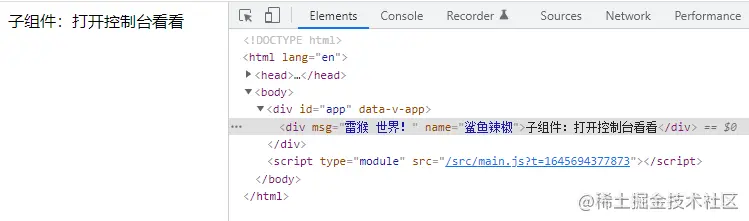
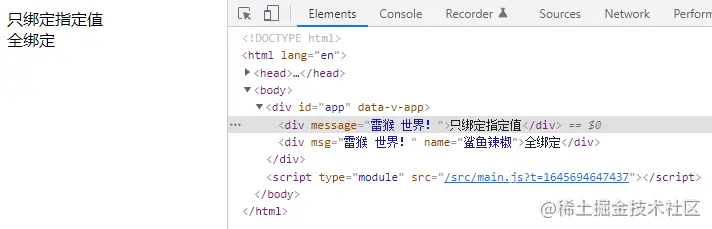
打开控制台可以看到,属性被挂到 HTML 元素上了。
多个元素的情况
但在 Vue3 中,组件已经没规定只能有一个根元素了。如果子组件是多个元素时,上面的例子就不生效了。
// Child.vue

<template>
  <div>子组件:打开控制台看看</div>
  <div>子组件:打开控制台看看</div>
</template>
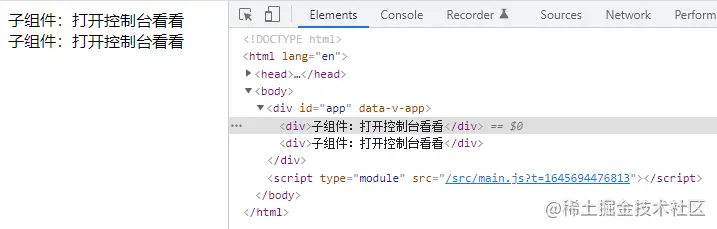
此时可以使用 $attrs 的方式进行绑定。
// Child.vue

<template>
  <div :message="$attrs.msg">只绑定指定值</div>
  <div v-bind="$attrs">全绑定</div>
</template>
v-model
v-model 是 Vue 的一个语法糖。在 Vue3 中的玩法就更多(晕)了。
单值的情况
组件上的 v-model 使用 modelValue 作为 prop 和 update:modelValue 作为事件。
v-model 参数文档
https://v3.cn.vuejs.org/guide/component-custom-events.html#v-model-%E5%8F%82%E6%95%B0
父组件
// Parent.vue

<template>
  <Child v-model="message" />
</template>

<script setup>
import { ref } from 'vue'
import Child from './components/Child.vue'

const message = ref('雷猴')
</script>
子组件
// Child.vue

<template>
  <div @click="handleClick">{{modelValue}}</div>
</template>

<script setup>
import { ref } from 'vue'

// 接收
const props = defineProps([
  'modelValue' // 接收父组件使用 v-model 传进来的值,必须用 modelValue 这个名字来接收
])

const emit = defineEmits(['update:modelValue']) // 必须用 update:modelValue 这个名字来通知父组件修改值

function handleClick() {
  // 参数1:通知父组件修改值的方法名
  // 参数2:要修改的值
  emit('update:modelValue', '喷射河马')
}

</script>
你也可以这样写,更加简单
子组件
// Child.vue

<template>
  <div @click="$emit('update:modelValue', '喷射河马')">{{modelValue}}</div>
</template>

<script setup>
import { ref } from 'vue'

// 接收
const props = defineProps([
  'modelValue' // 接收父组件使用 v-model 传进来的值,必须用 modelValue 这个名字来接收
])

</script>
多个 v-model 绑定
多个 v-model 绑定 文档
https://v3.cn.vuejs.org/guide/component-custom-events.html#%E5%A4%9A%E4%B8%AA-v-model-%E7%BB%91%E5%AE%9A
父组件
// Parent.vue

<template>
  <Child v-model:msg1="message1" v-model:msg2="message2" />
</template>

<script setup>
import { ref } from 'vue'
import Child from './components/Child.vue'

const message1 = ref('雷猴')

const message2 = ref('蟑螂恶霸')
</script>
子组件
// Child.vue

<template>
  <div><button @click="changeMsg1">修改msg1</button> {{msg1}}</div>

  <div><button @click="changeMsg2">修改msg2</button> {{msg2}}</div>
</template>

<script setup>
import { ref } from 'vue'

// 接收
const props = defineProps({
  msg1: String,
  msg2: String
})

const emit = defineEmits(['update:msg1', 'update:msg2'])

function changeMsg1() {
  emit('update:msg1', '鲨鱼辣椒')
}

function changeMsg2() {
  emit('update:msg2', '蝎子莱莱')
}

</script>
v-model 修饰符
v-model 还能通过 . 的方式传入修饰。
v-model 修饰符 文档
https://v3.cn.vuejs.org/guide/component-custom-events.html#%E5%A4%84%E7%90%86-v-model-%E4%BF%AE%E9%A5%B0%E7%AC%A6
父组件
// Parent.vue

<template>
  <Child v-model.uppercase="message" />
</template>

<script setup>
import { ref } from 'vue'
import Child from './components/Child.vue'

const message = ref('hello')
</script>
子组件
// Child.vue

<template>
  <div>{{modelValue}}</div>
</template>

<script setup>
import { ref, onMounted } from 'vue'

const props = defineProps([
  'modelValue',
  'modelModifiers'
])

const emit = defineEmits(['update:modelValue'])

onMounted(() => {
  // 判断有没有 uppercase 修饰符,有的话就执行 toUpperCase() 方法
  if (props.modelModifiers.uppercase) {
    emit('update:modelValue', props.modelValue.toUpperCase())
  }
})

</script>
插槽 slot
插槽可以理解为传一段 HTML 片段给子组件。子组件将 <slot></slot> 元素作为承载分发内容的出口。
插槽 文档
https://v3.cn.vuejs.org/guide/component-slots.html
本文打算讲讲日常用得比较多的3种插槽:默认插槽、具名插槽、作用域插槽。
默认插槽
插槽的基础用法非常简单,只需在 子组件 中使用 <slot></slot> 标签,就会将父组件传进来的 HTML 内容渲染出来。
默认插槽 文档
https://v3.cn.vuejs.org/guide/component-slots.html#%E6%8F%92%E6%A7%BD%E5%86%85%E5%AE%B9
父组件
// Parent.vue

<template>
  <Child>
    <div>雷猴啊</div>
  </Child>
</template>
子组件
// Child.vue

<template>
  <div>
    <slot></slot>
  </div>
</template>
具名插槽
具名插槽 就是在 默认插槽 的基础上进行分类,可以理解为对号入座。
具名插槽 文档
https://v3.cn.vuejs.org/guide/component-slots.html#%E5%85%B7%E5%90%8D%E6%8F%92%E6%A7%BD

父组件
// Parent.vue

<template>
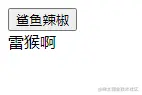
  <Child>
    <template v-slot:monkey>
      <div>雷猴啊</div>
    </template>

    <button>鲨鱼辣椒</button>
  </Child>
</template>
子组件
// Child.vue

<template>
  <div>
    <!-- 默认插槽 -->
    <slot></slot>
    <!-- 具名插槽 -->
    <slot name="monkey"></slot>
  </div>
</template>
父组件需要使用 <template></template> 标签,并在标签上使用 v-solt: + 名称 。
子组件需要在 <slot></slot> 标签里用 name= 名称 对应接收。
这就是 对号入座。
最后需要注意的是,插槽内容的排版顺序,是 以子组件里的排版为准。
上面这个例子就是这样,你可以仔细观察子组件传入顺序和子组件的排版顺序。
作用域插槽
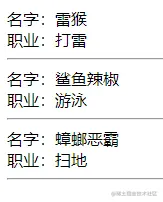
如果你用过 Element-Plus 这类 UI框架 的 Table ,应该就能很好的理解什么叫作用域插槽。
作用域插槽 文档
https://v3.cn.vuejs.org/guide/component-slots.html#%E4%BD%9C%E7%94%A8%E5%9F%9F%E6%8F%92%E6%A7%BD
父组件
// Parent.vue

<template>
  <!-- v-slot="{scope}" 获取子组件传上来的数据 -->
  <!-- :list="list" 把list传给子组件 -->
  <Child v-slot="{scope}" :list="list">
    <div>
      <div>名字:{{ scope.name }}</div>
      <div>职业:{{ scope.occupation }}</div>
      <hr>
    </div>
  </Child>
</template>

<script setup>
import { ref } from 'vue'
import Child from './components/Child.vue'

const list = ref([
  { name: '雷猴', occupation: '打雷'},
  { name: '鲨鱼辣椒', occupation: '游泳'},
  { name: '蟑螂恶霸', occupation: '扫地'},
])
</script>
子组件
// Child.vue

<template>
  <div>
    <!-- 用 :scope="item" 返回每一项 -->
    <slot v-for="item in list" :scope="item" />
  </div>
</template>

<script setup>
const props = defineProps({
  list: {
    type: Array,
    default: () => []
  }
})
</script>
我没写样式,所以用 hr 元素让视觉上看上去比较清晰我就是懒。
provide / inject
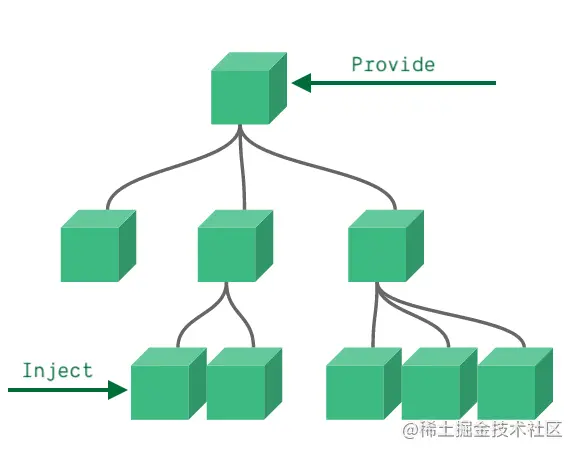
遇到多层传值时,使用 props 和 emit 的方式会显得比较笨拙。这时就可以用 provide 和 inject 了。
provide 是在父组件里使用的,可以往下传值。
inject 是在子(后代)组件里使用的,可以网上取值。
无论组件层次结构有多深,父组件都可以作为其所有子组件的依赖提供者。
provide / inject 文档
https://v3.cn.vuejs.org/guide/component-provide-inject.html
父组件
// Parent.vue

<template>
  <Child></Child>
</template>

<script setup>
import { ref, provide, readonly } from 'vue'
import Child from './components/Child.vue'

const name = ref('猛虎下山')
const msg = ref('雷猴')

// 使用readonly可以让子组件无法直接修改,需要调用provide往下传的方法来修改
provide('name', readonly(name))

provide('msg', msg)

provide('changeName', (value) => {
  name.value = value
})
</script>
子组件
// Child.vue

<template>
  <div>
    <div>msg: {{ msg }}</div>
    <div>name: {{name}}</div>
    <button @click="handleClick">修改</button>
  </div>
</template>

<script setup>
import { inject } from 'vue'

const name = inject('name', 'hello') // 看看有没有值,没值的话就适用默认值(这里默认值是hello)
const msg = inject('msg')
const changeName = inject('changeName')

function handleClick() {
  // 这样写不合适,因为vue里推荐使用单向数据流,当父级使用readonly后,这行代码是不会生效的。没使用之前才会生效。
  // name.value = '雷猴'

  // 正确的方式
  changeName('虎躯一震')

  // 因为 msg 没被 readonly 过,所以可以直接修改值
  msg.value = '世界'
}
</script>
provide 可以配合 readonly 一起使用,详情可以看上面例子和注释。
provide 和 inject 其实主要是用在深层关系中传值,上面的例子只有父子2层,只是为了举例说明我懒。
总线 bus
在 Vue2 有总线传值的方法,我们在 Vue3 中也可以自己模拟。
这个方式其实有点像 Vuex 或者 Pinia 那样,弄一个独立的工具出来专门控制数据。
但和 Vuex 或 Pinia 相比,我们自己写的这个方法并没有很好的数据跟踪之类的特性。
原理
我们创建一个 Bus.js 文件,用来控制数据和注册事件的。
Bus.js 里有一个 Bus 类
-
eventList是必须项,用来存放事件列表的。 -
constructor里除了eventList外,其他都是自定义数据,公共数据就是存在这里的。 -
$on方法用来注册事件。 -
$emit方法可以调用$on里的事件。 -
$off方法可以注销eventList里的事件。
然后需要用到总线的组件,都导入 Bus.js ,就可以共同操作一份数据了。
Bus.js
import { ref } from 'vue'

class Bus {
  constructor() {
    // 收集订阅信息,调度中心
	this.eventList = {}, // 事件列表,这项是必须的
    // 下面的都是自定义值
	this.msg = ref('这是一条总线的信息')
  }

  // 订阅
  $on(name, fn) {
	this.eventList[name] = this.eventList[name] || []
	this.eventList[name].push(fn)
  }

  // 发布
  $emit(name, data) {
	if (this.eventList[name]) {
      this.eventList[name].forEach((fn) => {
        fn(data)
      });
	}
  }

  // 取消订阅
  $off(name) {
      if (this.eventList[name]) {
	  delete this.eventList[name]
	}
  }
}

export default new Bus()
父组件
// Parent.vue

<template>
  <div>
    父组件:
    <span style="margin-right: 30px;">message: {{ message }}</span>
    <span>msg: {{ msg }}</span>
  </div>
  <Child></Child>
</template>

<script setup>
import { ref } from 'vue'
import Bus from './Bus.js'
import Child from './components/Child.vue'

const msg = ref(Bus.msg)

const message = ref('hello')

// 用监听的写法
Bus.$on('changeMsg', data => {
  message.value = data
})

</script>
子组件
// Child.vue

<template>
  <div>
    子组件:
    <button @click="handleBusEmit">触发Bus.$emit</button>
    <button @click="changeBusMsg">修改总线里的 msg</button>
  </div>
</template>

<script setup>
import Bus from '../Bus.js'

function handleBusEmit() {
  Bus.$emit('changeMsg', '雷猴啊')
}

function changeBusMsg() {
  // console.log(Bus.msg)
  Bus.msg.value = '在子组件里修改了总线的值'
}
</script>
这个方法其实还挺好用的,但光看可能有点懵,请大家务必亲手敲一下代码实践一下。
getCurrentInstance
getcurrentinstance 是 vue 提供的一个方法,支持访问内部组件实例。
getCurrentInstance只暴露给高阶使用场景,典型的比如在库中。强烈反对在应用的代码中使用getCurrentInstance。请不要把它当作在组合式 API 中获取this的替代方案来使用。
说白了,这个方法 适合在开发组件库的情况下使用,不适合日常业务开发中使用。
getCurrentInstance 只能在 setup 或生命周期钩子中调用。
getcurrentinstance 文档
https://v3.cn.vuejs.org/api/composition-api.html#getcurrentinstance
在 <script setup></script> 中,我模拟了类似 $parent 和 $children 的方式。
父组件
// Parent.vue

<template>
  <div>父组件 message 的值: {{ message }}</div>
  <button @click="handleClick">获取子组件</button>
  <Child></Child>
  <Child></Child>
</template>

<script setup>
import { ref, getCurrentInstance, onMounted } from 'vue'
import Child from './components/Child.vue'

const message = ref('雷猴啊')

let instance = null

onMounted(() => {
  instance = getCurrentInstance()
})

// 子组件列表
let childrenList = []

// 注册组件
function registrationCom(com) {
  childrenList.push(com)
}

function handleClick() {
  if (childrenList.length > 0) {
    childrenList.forEach(item => {
      console.log('组件实例:', item)
      console.log('组件名(name):', item.type.name)
      console.log('组件输入框的值:', item.devtoolsRawSetupState.inputValue)
      console.log('---------------------------------------')
    })
  }
}

</script>
子组件
// Child.vue

<template>
  <div>
    <div>----------------------------</div>
    子组件:<button @click="handleClick">获取父组件的值</button>
    <br>
    <input type="text" v-model="inputValue">
  </div>
</template>

<script>
export default {
  name: 'ccccc'
}
</script>

<script setup>
import { getCurrentInstance, onMounted, nextTick, ref } from 'vue'

const inputValue = ref('')

let instance = null

onMounted(() => {
  instance = getCurrentInstance()
  nextTick(() => {
    instance.parent.devtoolsRawSetupState.registrationCom(instance)
  })

})

function handleClick() {
  let msg = instance.parent.devtoolsRawSetupState.message
  msg.value = '哈哈哈哈哈哈'
}

</script>
可以将代码复制到你的项目中运行试试看,最好还是敲一遍咯。
Vuex
Vuex 主要解决 跨组件通信 的问题。
在 Vue3 中,需要使用 Vuex v4.x 版本。
安装
用 npm 或者 Yarn 安装到项目中。
npm install vuex@next --save

# 或

yarn add vuex@next --save
使用
安装成功后,在 src 目录下创建 store 目录,再在 store 下创建 index.js 文件。
// store/index.js

import { createStore } from 'vuex'

export default createStore({
  state: {
  },
  getters: {
  },
  mutations: {
  },
  actions: {
  },
  modules: {
  }
})
在 store/index.js 下输入以上内容。
-
state:数据仓库,用来存数据的。 -
getters:获取数据的,有点像computed的用法(个人觉得)。 -
mutations: 更改state数据的方法都要写在mutations里。 -
actions:异步异步异步,异步的方法都写在这里,但最后还是需要通过mutations来修改state的数据。 -
modules:分包。如果项目比较大,可以将业务拆散成独立模块,然后分文件管理和存放。
然后在 src/main.js 中引入
import { createApp } from 'vue'
import App from './App.vue'
import store from './store'

const app = createApp(App)

app
  .use(store)
  .mount('#app')
State
store/index.js
// store/index.js

import { createStore } from 'vuex'

export default createStore({
  state: {
    msg: '雷猴'
  }
})
组件
// xxx.vue

<script setup>
import { useStore } from 'vuex'

const store = useStore()

console.log(store.state.msg) // 雷猴
</script>
Getter
我觉得 Getter 方法和 computed 是有点像的。
比如我们需要过滤一下数据,或者返回时组装一下数据,都可以用 Getter 方法。
store/index.js
// store/index.js

import { createStore } from 'vuex'

export default createStore({
  state: {
    msg: '雷猴'
  },
  getters: {
    getMsg(state) {
      return state.msg + ' 世界!'
    }
  }
})
组件
// xxx.vue

<script setup>
import { useStore } from 'vuex'

const store = useStore()

console.log(store.getters.getMsg) // 雷猴 世界!
</script>
Mutation
Mutation 是修改 State 数据的唯一方法,这样 Vuex 才可以跟踪数据流向。
在组件中通过 commit 调用即可。
store/index.js
// store/index.js

import { createStore } from 'vuex'

export default createStore({
  state: {
    msg: '雷猴'
  },
  mutations: {
    changeMsg(state, data) {
      state.msg = data
    }
  }
})
组件
// xxx.vue

<script setup>
import { useStore } from 'vuex'

const store = useStore()

store.commit('changeMsg', '蒜头王八')

console.log(store.state.msg) // 蒜头王八
</script>
Action
我习惯将异步的东西放在 Action 方法里写,然后在组件使用 dispatch 方法调用。
store/index.js
// store/index.js

import { createStore } from 'vuex'

export default createStore({
  state: {
    msg: '雷猴'
  },
  mutations: {
    changeMsg(state, data) {
      state.msg = data
    }
  },
  actions: {
    fetchMsg(context) {
      // 模拟ajax请求
      setTimeout(() => {
        context.commit('changeMsg', '鲨鱼辣椒')
      }, 1000)
    }
  }
})
组件
// xxx.vue

<script setup>
import { useStore } from 'vuex'

const store = useStore()

store.dispatch('fetchMsg')
</script>
Module
Module 就是传说中的分包了。这需要你将不同模块的数据拆分成一个个 js 文件。
我举个例子,目录如下
store
|- index.js
|- modules/
  |- user.js
  |- goods.js
-
index.js对外的出口(主文件) -
modules/user.js用户相关模块 -
modules/goods.js商品模块
index.js
import { createStore } from 'vuex'
import user from './modules/user'
import goods from './modules/goods'

export default createStore({
  state: {},
  getters: {},
  mutations: {},
  actions: {},
  modules: {
    user,
    goods
  }
})
user.js
const user = {
  state: {
  },
  getters: {
  },
  mutations: {
  },
  actions: {
  }
}

export default user
goods.js
const goods = {
  state: {
  },
  getters: {
  },
  mutations: {
  },
  actions: {
  }
}

export default goods
然后在各个模块里放入相应的数据和方法就行。
在组建中调用方法和访问数据,都和之前的用法差不多的。
以上就是 Vuex 的基础用法。除此之外,Vuex 还有各种语法糖,大家可以自行查阅 官方文档(https://vuex.vuejs.org/zh/)
Pinia
Pinia 是最近比较火热的一个工具,也是用来处理 跨组件通信 的,极大可能成为 Vuex 5 。
Pinia 文档
https://pinia.vuejs.org/
从我使用 Pinia 一阵后的角度来看,Pinia 跟 Vuex 相比有以下优点:
- 调用时代码跟简洁了。
- 对
TS更友好。 - 合并了
Vuex的Mutation和Action。天然的支持异步了。 - 天然分包。
除此之外,Pinia 官网还说它适用于 Vue2 和 Vue3。但我没试过在 Vue2 中使用我懒得试。
Pinia 简化了状态管理模块,只用这3个东西就能应对日常大多任务。
-
state:存储数据的仓库 -
getters:获取和过滤数据(跟computed有点像) -
actions:存放 “修改state”的方法
我举个简单的例子
安装
npm install pinia

# 或

yarn add pinia
注册
在 src 目录下创建 store 目录,再在 store 里创建 index.js 和 user.js
目录结构如下
store
|- index.js
|- user.js
index.js
import { createPinia } from 'pinia'

const store = createPinia()

export default store
user.js
常见的写法有2种,选其中一种就行。
import { defineStore } from 'pinia'

// 写法1
export const useUserStore = defineStore({
  id: 'user', // id必填,且需要唯一
  state: () => {
    return {
      name: '雷猴'
    }
  },
  getters: {
    fullName: (state) => {
      return '我叫 ' + state.name
    }
  },
  actions: {
    updateName(name) {
      this.name = name
    }
  }
})


// 写法2
export const useUserStore = defineStore('user',{
  state: () => {
    return {
      name: '雷猴'
    }
  },
  getters: {
    fullName: (state) => {
      return '我叫 ' + state.name
    }
  },
  actions: {
    updateName(name) {
      this.name = name
    }
  }
})
然后在 src/main.js 中引入 store/index.js
src/main.js
import { createApp } from 'vue'
import App from './App.vue'
import store from './store'

const app = createApp(App)

app
  .use(store)
  .mount('#app')
在组件中使用
组件
// xxx.vue

<template>
  <div>
    <div>name: {{ name }}</div>
    <div>全名:{{ fullName }}</div>
    <button @click="handleClick">修改</button>
  </div>
</template>

<script setup>
import { computed } from 'vue'
import { storeToRefs } from 'pinia'
import { useUserStore } from '@/store/user'

const userStore = useUserStore()

// const name = computed(() => userStore.name)

// 建议
const { name, fullName } = storeToRefs(userStore)


function handleClick() {
  // 不建议这样改
  // name.value = '蝎子莱莱'

  // 推荐的写法!!!
  userStore.updateName('李四')
}
</script>
啰嗦两句
其实 Pinia 的用法和 Vuex 是挺像的,默认就是分包的逻辑,在这方面我支持 菠萝(Pinia)。
Pinia 还提供了多种语法糖,强烈建议阅读一下 官方文档(https://pinia.vuejs.org/)。
mitt.js
我们前面用到的 总线 Bus 方法,其实和 mitt.js 有点像,但 mitt.js 提供了更多的方法。
比如:
-
on:添加事件 -
emit:执行事件 -
off:移除事件 -
clear:清除所有事件
mitt.js 不是专门给 Vue 服务的,但 Vue 可以利用 mitt.js 做跨组件通信。
github 地址:https://github.com/developit/mitt
npm 地址:https://www.npmjs.com/package/mitt
安装
npm i mitt
使用
我模拟一下 总线Bus 的方式。
我在同级目录创建3个文件用作模拟。
Parent.vue
Child.vue
Bus.js
Bus.js
// Bus.js

import mitt from 'mitt'
export default mitt()
Parent.vue
// Parent.vue

<template>
  <div>
    Mitt
    <Child />
  </div>
</template>

<script setup>
import Child from './Child.vue'
import Bus from './Bus.js'

Bus.on('sayHello', () => console.log('雷猴啊'))
</script>
Child.vue
// Child.vue

<template>
  <div>
    Child:<button @click="handleClick">打声招呼</button>
  </div>
</template>

<script setup>
import Bus from './Bus.js'

function handleClick() {
  Bus.emit('sayHello')
}
</script>
此时,点击 Child.vue 上的按钮,在控制台就会执行在 Parent.vue 里定义的方法。
mitt.js 的用法其实很简单,建议跟着 官方示例 敲一下代码,几分钟就上手了。




