



最近写完mysql flashback,突然发现还有有这种使用场景:有些情况下,可能会统计在某个时间段内,mysql修改了多少数据量?发生了多少事务?主要是哪些表格发生变动?变动的数量是怎么样的? 但是却不需要行记录的修改内容,只需要了解 行数据的 变动情况。故也整理了下。
昨晚写的脚本,因为个人python能力有限,本来想这不发这文,后来想想,没准会有哪位园友给出优化建议。
1 实现内容
有些情况下,可能会统计在某个时间段内,MySQL修改了多少数据量?发生了多少事务?主要是哪些表格发生变动?变动的数量是怎么样的? 但是却不需要行记录的修改内容,只需要了解 行数据的 变动情况。
这些情况部分可以通过监控来大致了解,但是也可以基于binlog来全盘分析,binlog的格式是row模式。
在写flashback的时候,顺带把这个也写了个脚步,使用python编写,都差不多原理,只是这个简单些,介于个人python弱的不行,性能可能还有很大的提升空间,也希望园友能协助优化下。
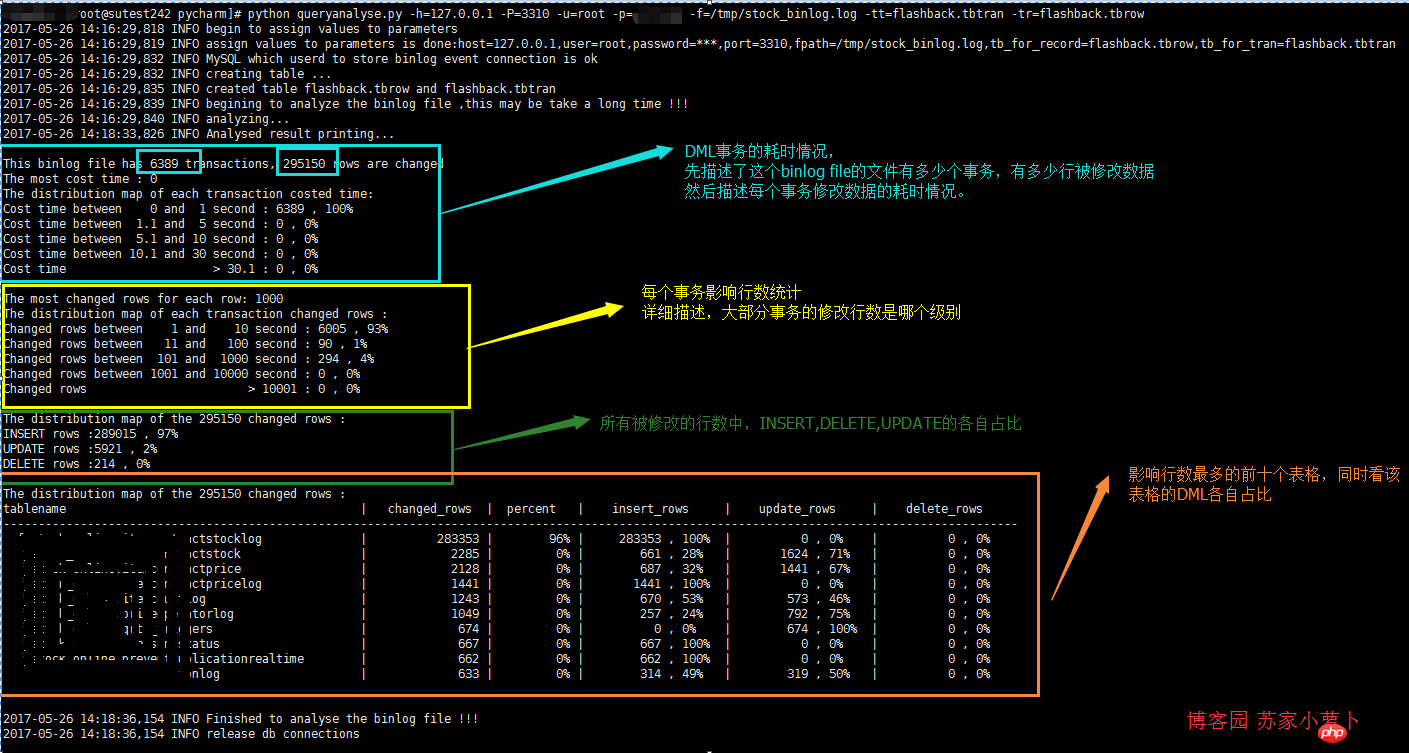
先贴python脚步的分析结果图如下,分为4个部分:事务耗时情况、事务影响行数情况、DML行数情况以及操作最频繁表格情况。
2 脚本简单描述
脚本依赖的模块中,pymysql需要自行安装。
创建类queryanalyse,其中有5个函数定义:_get_db、create_tab、rowrecord、binlogdesc跟closeconn。
2.1 _get_db
该函数用来解析输入参数值,参数值一共有7个,都是必须填写的。分别为host,user,password,port,table name for transaction,table name for records,对应的简写如下:
ALL options need to assign:
-h : host, the database host,which database will store the results after analysis
-u : user, the db user
-p : password, the db user's password
-P : port, the db port
-f : file path, the binlog file
-tr : table name for record , the table name to store the row record
-tt : table name for transaction, the table name to store transactions
比如,执行脚本:python queryanalyse.py -h=127.0.0.1 -P=3310 -u=root -p=password -f=/tmp/stock_binlog.log -tt=flashback.tbtran -tr=flashback.tbrow,该函数负责处理各个选项的参数值情况,并存储。
2.2 create_tab
创建两个表格,分别用来存储 binlog file文件的分析结果。一个用来存储事务的执行开始时间跟结束时间,由选项 -tt来赋值表名;一个是用来存储每一行记录的修改情况,由选项 -tr来赋值表名。
事务表记录内容:事务的开始时间及事务的结束时间。
行记录表的内容:库名,表名,DML类型以及事务对应事务表的编号。
root@localhost:mysql3310.sock  14:42:29 [flashback]>show create table tbrow \G*************************** 1. row ***************************
       Table: tbrowCreate Table: CREATE TABLE `tbrow` (
  `auto_id` int(10) unsigned NOT NULL AUTO_INCREMENT,
  `sqltype` int(11) NOT NULL COMMENT '1 is insert,2 is update,3 is delete',
  `tran_num` int(11) NOT NULL COMMENT 'the transaction number',
  `dbname` varchar(50) NOT NULL,
  `tbname` varchar(50) NOT NULL,  PRIMARY KEY (`auto_id`),  KEY `sqltype` (`sqltype`),  KEY `dbname` (`dbname`),  KEY `tbname` (`tbname`)
) ENGINE=InnoDB AUTO_INCREMENT=295151 DEFAULT CHARSET=utf81 row in set (0.00 sec)

root@localhost:mysql3310.sock  14:42:31 [flashback]>SHOW CREATE TABLE TBTRAN \G*************************** 1. row ***************************
       Table: TBTRANCreate Table: CREATE TABLE `tbtran` (
  `auto_id` int(10) unsigned NOT NULL AUTO_INCREMENT,
  `begin_time` datetime NOT NULL,
  `end_time` datetime NOT NULL,  PRIMARY KEY (`auto_id`)
) ENGINE=InnoDB AUTO_INCREMENT=6390 DEFAULT CHARSET=utf81 row in set (0.00 sec)
2.3 rowrecord
重点函数,分析binlog文件内容。这里有几个规律:

每个事务的结束点,是以 'Xid = ' 来查找
事务的开始时间,是事务内的第一个 'Table_map' 行里边的时间
事务的结束时间,是以 'Xid = '所在行的 里边的时间
每个行数据是属于哪个表格,是以 'Table_map'来查找
DML的类型是按照 行记录开头的情况是否为:'### INSERT INTO' 、'### UPDATE' 、'### DELETE FROM'
注意,单个事务可以包含多个表格多种DML多行数据修改的情况。
2.4 binlogdesc
描述分析结果,简单4个SQL分析。
分析修改行数据的 事务耗时情况
分析修改行数据的 事务影响行数情况
分析DML分布情况
分析 最多DML操作的表格 ,取前十个分析
2.5 closeconn
关闭数据库连接。
3 使用说明
首先,确保python安装了pymysql模块,把python脚本拷贝到文件 queryanalyse.py。
然后,把要分析的binlog文件先用 mysqlbinlog 指令分析存储,具体binlog的文件说明,可以查看之前的博文:关于binary log那些事——认真码了好长一篇。mysqlbinlog的指令使用方法,可以详细查看文档:表格0dev.mysql.com/doc/refman/5.7/en/mysqlbinlog.html 。
比较常用通过指定开始时间跟结束时间来分析 binlog文件。
mysqlbinlog --start-datetime='2017-04-23 00:00:03' --stop-datetime='2017-04-23 00:30:00' --base64-output=decode-rows -v /data/mysql/logs/mysql-bin.007335 > /tmp/binlog_test.log
分析后,可以把这个 binlog_test.log文件拷贝到其他空闲服务器执行分析,只需要有个空闲的DB来存储分析记录即可。
假设这个时候,拷贝 binlog_test.log到测试服务器上,测试服务器上的数据库可以用来存储分析内容,则可以执行python脚本了,注意要进入到python脚本的目录中,或者指定python脚本路径。
python queryanalyse.py -h=127.0.0.1 -P=3310 -u=root -p=password -f= /tmp/binlog_test.log -tt=flashback.tbtran -tr=flashback.tbrow
没了,就等待输出吧。
性能是硬伤,在虚拟机上测试,大概500M的binlog文件需要分析2-3min,有待提高!
4 python脚本
  1 import pymysql  2 from pymysql.cursors import DictCursor  3 import re  4 import os  5 import sys  6 import datetime  7 import time  8 import logging  9 import importlib 10 importlib.reload(logging) 11 logging.basicConfig(level=logging.DEBUG,format='%(asctime)s %(levelname)s %(message)s ') 12  13  14 usage=''' usage: python [script's path] [option] 15 ALL options need to assign: 16  17 -h     : host, the database host,which database will store the results after analysis
 18 -u     : user, the db user 19 -p     : password, the db user's password 20 -P     : port, the db port 21 -f     : file path, the binlog file 22 -tr    : table name for record , the table name to store the row record 23 -tt    : table name for transaction, the table name to store transactions 24 Example: python queryanalyse.py -h=127.0.0.1 -P=3310 -u=root -p=password -f=/tmp/stock_binlog.log -tt=flashback.tbtran -tr=flashback.tbrow 25  26 ''' 27  28 class queryanalyse: 29     def init(self): 30         #初始化 31         self.host='' 32         self.user='' 33         self.password='' 34         self.port='3306' 35         self.fpath='' 36         self.tbrow='' 37         self.tbtran='' 38  39         self._get_db() 40         logging.info('assign values to parameters is done:host={},user={},password=***,port={},fpath={},tb_for_record={},tb_for_tran={}'.format(self.host,self.user,self.port,self.fpath,self.tbrow,self.tbtran)) 41  42         self.mysqlconn = pymysql.connect(host=self.host, user=self.user, password=self.password, port=self.port,charset='utf8') 43         self.cur = self.mysqlconn.cursor(cursor=DictCursor) 44         logging.info('MySQL which userd to store binlog event connection is ok') 45  46         self.begin_time='' 47         self.end_time='' 48         self.db_name='' 49         self.tb_name='' 50  51     def _get_db(self): 52         #解析用户输入的选项参数值,这里对password的处理是明文输入,可以自行处理成是input格式, 53         #由于可以拷贝binlog文件到非线上环境分析,所以password这块,没有特殊处理 54         logging.info('begin to assign values to parameters') 55         if len(sys.argv) == 1: 56             print(usage) 57             sys.exit(1) 58         elif sys.argv[1] == '--help': 59             print(usage) 60             sys.exit() 61         elif len(sys.argv) > 2: 62             for i in sys.argv[1:]: 63                 _argv = i.split('=') 64                 if _argv[0] == '-h': 65                     self.host = _argv[1] 66                 elif _argv[0] == '-u': 67                     self.user = _argv[1] 68                 elif _argv[0] == '-P': 69                     self.port = int(_argv[1]) 70                 elif _argv[0] == '-f': 71                     self.fpath = _argv[1] 72                 elif _argv[0] == '-tr': 73                     self.tbrow = _argv[1] 74                 elif _argv[0] == '-tt': 75                     self.tbtran = _argv[1] 76                 elif _argv[0] == '-p': 77                     self.password = _argv[1] 78                 else: 79                     print(usage) 80  81     def create_tab(self): 82         #创建两个表格:一个用户存储事务情况,一个用户存储每一行数据修改的情况 83         #注意,一个事务可以存储多行数据修改的情况 84         logging.info('creating table ...') 85         create_tb_sql ='''CREATE TABLE IF NOT EXISTS  {} ( 86                           `auto_id` int(10) unsigned NOT NULL AUTO_INCREMENT, 87                           `begin_time` datetime NOT NULL, 88                           `end_time` datetime NOT NULL, 89                           PRIMARY KEY (`auto_id`) 90                         ) ENGINE=InnoDB DEFAULT CHARSET=utf8; 91                         CREATE TABLE IF NOT EXISTS  {} ( 92                           `auto_id` int(10) unsigned NOT NULL AUTO_INCREMENT, 93                           `sqltype` int(11) NOT NULL COMMENT '1 is insert,2 is update,3 is delete', 94                           `tran_num` int(11) NOT NULL COMMENT 'the transaction number', 95                           `dbname` varchar(50) NOT NULL, 96                           `tbname` varchar(50) NOT NULL, 97                           PRIMARY KEY (`auto_id`), 98                           KEY `sqltype` (`sqltype`), 99                           KEY `dbname` (`dbname`),100                           KEY `tbname` (`tbname`)101                         ) ENGINE=InnoDB DEFAULT CHARSET=utf8;102                         truncate table {};103                         truncate table {};104                         '''.format(self.tbtran,self.tbrow,self.tbtran,self.tbrow)105 106         self.cur.execute(create_tb_sql)107         logging.info('created table {} and {}'.format(self.tbrow,self.tbtran))108 109     def rowrecord(self):110         #处理每一行binlog111         #事务的结束采用 'Xid =' 来划分112         #分析结果,按照一个事务为单位存储提交一次到db113         try:114             tran_num=1    #事务数115             record_sql='' #行记录的insert sql116             tran_sql=''   #事务的insert sql117 118             self.create_tab()119 120             with open(self.fpath,'r') as binlog_file:121                 logging.info('begining to analyze the binlog file ,this may be take a long time !!!')122                 logging.info('analyzing...')123 124124                 for bline in binlog_file:125 126                     if bline.find('Table_map:') != -1:127                         l = bline.index('server')128                         n = bline.index('Table_map')129                         begin_time = bline[:l:].rstrip(' ').replace('#', '20')130 131                         if record_sql=='':132                             self.begin_time = begin_time[0:4] + '-' + begin_time[4:6] + '-' + begin_time[6:]133 134                         self.db_name = bline[n::].split(' ')[1].replace('`', '').split('.')[0]135                         self.tb_name = bline[n::].split(' ')[1].replace('`', '').split('.')[1]136                         bline=''137 138                     elif bline.startswith('### INSERT INTO'):139                        record_sql=record_sql+"insert into {}(sqltype,tran_num,dbname,tbname) VALUES (1,{},'{}','{}');".format(self.tbrow,tran_num,self.db_name,self.tb_name)140 141                     elif bline.startswith('### UPDATE'):142                        record_sql=record_sql+"insert into {}(sqltype,tran_num,dbname,tbname) VALUES (2,{},'{}','{}');".format(self.tbrow,tran_num,self.db_name,self.tb_name)143 144                     elif bline.startswith('### DELETE FROM'):145                        record_sql=record_sql+"insert into {}(sqltype,tran_num,dbname,tbname) VALUES (3,{},'{}','{}');".format(self.tbrow,tran_num,self.db_name,self.tb_name)146 147                     elif bline.find('Xid =') != -1:148 149                         l = bline.index('server')150                         end_time = bline[:l:].rstrip(' ').replace('#', '20')151                         self.end_time = end_time[0:4] + '-' + end_time[4:6] + '-' + end_time[6:]152                         tran_sql=record_sql+"insert into {}(begin_time,end_time) VALUES ('{}','{}')".format(self.tbtran,self.begin_time,self.end_time)153 154                         self.cur.execute(tran_sql)155                         self.mysqlconn.commit()156                         record_sql = ''157                         tran_num += 1158 159         except Exception:160             return 'funtion rowrecord error'161 162     def binlogdesc(self):163         sql=''164         t_num=0165         r_num=0166         logging.info('Analysed result printing...\n')167         #分析总的事务数跟行修改数量168         sql="select 'tbtran' name,count(*) nums from {}  union all select 'tbrow' name,count(*) nums from {};".format(self.tbtran,self.tbrow)169         self.cur.execute(sql)170         rows=self.cur.fetchall()171         for row in rows:172             if row['name']=='tbtran':173                 t_num = row['nums']174             else:175                 r_num = row['nums']176         print('This binlog file has {} transactions, {} rows are changed '.format(t_num,r_num))177 178         # 计算 最耗时 的单个事务179         # 分析每个事务的耗时情况,分为5个时间段来描述180         # 这里正常应该是 以毫秒来分析的,但是binlog中,只精确时间到second181         sql='''select
182                       count(case when cost_sec between 0 and 1 then 1 end ) cos_1,183                       count(case when cost_sec between 1.1 and 5 then 1 end ) cos_5,184                       count(case when cost_sec between 5.1 and 10 then 1 end ) cos_10,185                       count(case when cost_sec between 10.1 and 30 then 1 end ) cos_30,186                       count(case when cost_sec >30.1 then 1 end ) cos_more,187                       max(cost_sec) cos_max188                 from
189                 (190                         select
191                             auto_id,timestampdiff(second,begin_time,end_time) cost_sec192                         from {}193                 ) a;'''.format(self.tbtran)194         self.cur.execute(sql)195         rows=self.cur.fetchall()196 197         for row in rows:198             print('The most cost time : {} '.format(row['cos_max']))199             print('The distribution map of each transaction costed time: ')200             print('Cost time between    0 and  1 second : {} , {}%'.format(row['cos_1'],int(row['cos_1']*100/t_num)))201             print('Cost time between  1.1 and  5 second : {} , {}%'.format(row['cos_5'], int(row['cos_5'] * 100 / t_num)))202             print('Cost time between  5.1 and 10 second : {} , {}%'.format(row['cos_10'], int(row['cos_10'] * 100 / t_num)))203             print('Cost time between 10.1 and 30 second : {} , {}%'.format(row['cos_30'], int(row['cos_30'] * 100 / t_num)))204             print('Cost time                     > 30.1 : {} , {}%\n'.format(row['cos_more'], int(row['cos_more'] * 100 / t_num)))205 206         # 计算 单个事务影响行数最多 的行数量207         # 分析每个事务 影响行数 情况,分为5个梯度来描述208         sql='''select
209                     count(case when nums between 0 and 10 then 1 end ) row_1,210                     count(case when nums between 11 and 100 then 1 end ) row_2,211                     count(case when nums between 101 and 1000 then 1 end ) row_3,212                     count(case when nums between 1001 and 10000 then 1 end ) row_4,213                     count(case when nums >10001 then 1 end ) row_5,214                     max(nums) row_max215                from
216                   (217                     select
218                              count(*) nums219                     from {} group by tran_num220                    ) a;'''.format(self.tbrow)221         self.cur.execute(sql)222         rows=self.cur.fetchall()223 224         for row in rows:225             print('The most changed rows for each row: {} '.format(row['row_max']))226             print('The distribution map of each transaction changed rows : ')227             print('Changed rows between    1 and    10 second : {} , {}%'.format(row['row_1'],int(row['row_1']*100/t_num)))228             print('Changed rows between   11 and   100 second : {} , {}%'.format(row['row_2'], int(row['row_2'] * 100 / t_num)))229             print('Changed rows between  101 and  1000 second : {} , {}%'.format(row['row_3'], int(row['row_3'] * 100 / t_num)))230             print('Changed rows between 1001 and 10000 second : {} , {}%'.format(row['row_4'], int(row['row_4'] * 100 / t_num)))231             print('Changed rows                       > 10001 : {} , {}%\n'.format(row['row_5'], int(row['row_5'] * 100 / t_num)))232 233         # 分析 各个行数 DML的类型情况234         # 描述 delete,insert,update的分布情况235         sql='select sqltype ,count(*) nums from {} group by sqltype ;'.format(self.tbrow)236         self.cur.execute(sql)237         rows=self.cur.fetchall()238 239         print('The distribution map of the {} changed rows : '.format(r_num))240         for row in rows:241 242             if row['sqltype']==1:243                 print('INSERT rows :{} , {}% '.format(row['nums'],int(row['nums']*100/r_num)))244             if row['sqltype']==2:245                 print('UPDATE rows :{} , {}% '.format(row['nums'],int(row['nums']*100/r_num)))246             if row['sqltype']==3:247                 print('DELETE rows :{} , {}%\n '.format(row['nums'],int(row['nums']*100/r_num)))248 249         # 描述 影响行数 最多的表格250         # 可以分析是哪些表格频繁操作,这里显示前10个table name251         sql = '''select
252                       dbname,tbname ,253                       count(*) ALL_rows,254                       count(*)*100/{} per,255                       count(case when sqltype=1 then 1 end) INSERT_rows,256                       count(case when sqltype=2 then 1 end) UPDATE_rows,257                       count(case when sqltype=3 then 1 end) DELETE_rows258                 from {}
259                 group by dbname,tbname
260                 order by ALL_rows desc
261 limit 10;'''.format(r_num,self.tbrow)262 self.cur.execute(sql)263 rows = self.cur.fetchall()264 265 print('The distribution map of the {} changed rows : '.format(r_num))266 print('tablename'.ljust(50),267 '|','changed_rows'.center(15),268 '|','percent'.center(10),269 '|','insert_rows'.center(18),270 '|','update_rows'.center(18),271 '|','delete_rows'.center(18)272 )273 print('-------------------------------------------------------------------------------------------------------------------------------------------------')274 for row in rows:275 print((row['dbname']+'.'+row['tbname']).ljust(50),276 '|',str(row['ALL_rows']).rjust(15),277 '|',(str(int(row['per']))+'%').rjust(10),278 '|',str(row['INSERT_rows']).rjust(10)+' , '+(str(int(row['INSERT_rows']*100/row['ALL_rows']))+'%').ljust(5),279 '|',str(row['UPDATE_rows']).rjust(10)+' , '+(str(int(row['UPDATE_rows']*100/row['ALL_rows']))+'%').ljust(5),280 '|',str(row['DELETE_rows']).rjust(10)+' , '+(str(int(row['DELETE_rows']*100/row['ALL_rows']))+'%').ljust(5),281 )282 print('\n')283 284 logging.info('Finished to analyse the binlog file !!!')285 286 def closeconn(self):287 self.cur.close()288 logging.info('release db connections\n')289 290 def main():291 p = queryanalyse()292 p.rowrecord()293 p.binlogdesc()294 p.closeconn()295 296 if name == "main":297 main() 




