
we have to print the data of nodes of the linked list at the given index. unlike array linked list generally don’t have index so we have to traverse the whole linked list and print the data when we reached a particular.
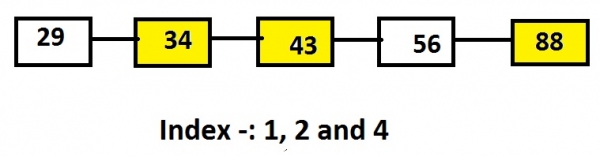
Let’s say, list contains the nodes 29, 34, 43, 56 and 88 and the value of indexes are 1, 2 and 4 than the output will be the nodes at these indexes that are 34, 43 and 88.
Example
Linked list: 29->34->43->56->88
Input: 1 2 4
Output: 34 43 88
In above representation of Linked List the yellow highlighted nodes are the nodes to be printed or the nodes which are on a particular index.
The approach used here involves taking of one pointer and one counter variable initialised to 1 that will incremented whenever the node is traversed. The counter is matched with the key value. When the key matches with the counter value the pointer pointing to the node structure will print the node’s data and incremented to next node and so on giving us the nodes at particular key.

立即学习“C语言免费学习笔记(深入)”;
The below code shows the c implementation of the algorithm given.
Algorithm
START
   Step 1 -> create node variable of type structure
      Declare int data
      Declare pointer of type node using *next
   Step 2 -> create struct node* intoList(int data)
      Create newnode using malloc
      Set newnode->data = data
      newnode->next = NULL
      return newnode
   step 3 -> Declare function void displayList(struct node *catchead)
      create struct node *temp
      IF catchead = NULL
         Print list is empty
         return
      End
      Set temp = catchead
      Loop While (temp != NULL)
         print temp->data
         set temp = temp->next
      End
   Step 4 -> Declare Function int search(int key,struct node *head)
      Set int index
      Create struct node *newnode
      Set index = 0 and newnode = head
      Loop While (newnode != NULL & newnode->data != key)
         Set index++
         Set newnode = newnode->next
      End
      return (newnode != NULL) ? index : -1
   step 5 -> In Main()
      create node using struct node* head = intoList(9)
      call displayList(head)
      set index = search(24,head)
      IF (index >= 0)
         Print index
      Else
         Print not found in the list
      EndIF
STOP
Example
#include <stdio.h>
#include <stdlib.h>
//structure of a node
struct node {
   int data;
   struct node *next;
};
struct node* intoList(int data) {
   struct node* newnode = (struct node*)malloc(sizeof(struct node));
   newnode->data = data;
   newnode->next = NULL;
   return newnode;
}
//funtion to display list
void displayList(struct node *catchead) {
   struct node *temp;
   if (catchead == NULL) {
      printf("List is empty.</p><p>");
      return;
   }
   printf("elements of list are : ");
   temp = catchead;
   while (temp != NULL) {
      printf("%d ", temp->data);
      temp = temp->next;
   }
   printf("</p><p>");
}
//function to search element
int search(int key,struct node *head) {
   int index;
   struct node *newnode;
   index = 0;
   newnode = head;
   while (newnode != NULL && newnode->data != key) {
      index++;
      newnode = newnode->next;
   }
   return (newnode != NULL) ? index : -1;
}
int main() {
   int index;
   struct node* head = intoList(9); //inserting elements into a list
   head->next = intoList(76);
   head->next->next = intoList(13);
   head->next->next->next = intoList(24);
   head->next->next->next->next = intoList(55);
   head->next->next->next->next->next = intoList(109);
   displayList(head);
   index = search(24,head);
   if (index >= 0)
      printf("%d found at position %d</p><p>", 24, index);
   else
      printf("%d not found in the list.</p><p>", 24);
   index=search(55,head);
   if (index >= 0)
      printf("%d found at position %d</p><p>", 55, index);
   else
   printf("%d not found in the list.</p><p>", 55);
}
输出
如果我们运行上面的程序,它将生成以下输出。
elements of list are : 9 76 13 24 55 109
24 found at position 3
55 found at position 4