
本篇文章主要介绍了python守护进程和脚本单例运行,小编觉得挺不错的,现在分享给大家,也给大家做个参考。一起跟随小编过来看看吧
一、简介
守护进程最重要的特性是后台运行;它必须与其运行前的环境隔离开来,这些环境包括未关闭的文件描述符、控制终端、会话和进程组、工作目录以及文件创建掩码等;它可以在系统启动时从启动脚本/etc/rc.d中启动,可以由inetd守护进程启动,也可以有作业规划进程crond启动,还可以由用户终端(通常是shell)执行。
Python有时需要保证只运行一个脚本实例,以避免数据的冲突。
二、Python守护进程
立即学习“Python免费学习笔记(深入)”;
1、函数实现
#!/usr/bin/env python
#coding: utf-8
import sys, os

'''将当前进程fork为一个守护进程
  注意:如果你的守护进程是由inetd启动的,不要这样做!inetd完成了
  所有需要做的事情,包括重定向标准文件描述符,需要做的事情只有chdir()和umask()了
'''

def daemonize (stdin='/dev/null', stdout='/dev/null', stderr='/dev/null'):
   #重定向标准文件描述符(默认情况下定向到/dev/null)
  try:
    pid = os.fork()
     #父进程(会话组头领进程)退出,这意味着一个非会话组头领进程永远不能重新获得控制终端。
    if pid > 0:
      sys.exit(0)  #父进程退出
  except OSError, e:
    sys.stderr.write ("fork #1 failed: (%d) %s\n" % (e.errno, e.strerror) )
    sys.exit(1)

   #从母体环境脱离
  os.chdir("/") #chdir确认进程不保持任何目录于使用状态,否则不能umount一个文件系统。也可以改变到对于守护程序运行重要的文件所在目录
  os.umask(0)  #调用umask(0)以便拥有对于写的任何东西的完全控制,因为有时不知道继承了什么样的umask。
  os.setsid()  #setsid调用成功后,进程成为新的会话组长和新的进程组长,并与原来的登录会话和进程组脱离。

   #执行第二次fork
  try:
    pid = os.fork()
    if pid > 0:
      sys.exit(0)  #第二个父进程退出
  except OSError, e:
    sys.stderr.write ("fork #2 failed: (%d) %s\n" % (e.errno, e.strerror) )
    sys.exit(1)

   #进程已经是守护进程了,重定向标准文件描述符

  for f in sys.stdout, sys.stderr: f.flush()
  si = open(stdin, 'r')
  so = open(stdout, 'a+')
  se = open(stderr, 'a+', 0)
  os.dup2(si.fileno(), sys.stdin.fileno())  #dup2函数原子化关闭和复制文件描述符
  os.dup2(so.fileno(), sys.stdout.fileno())
  os.dup2(se.fileno(), sys.stderr.fileno())

#示例函数:每秒打印一个数字和时间戳
def main():
  import time
  sys.stdout.write('Daemon started with pid %d\n' % os.getpid())
  sys.stdout.write('Daemon stdout output\n')
  sys.stderr.write('Daemon stderr output\n')
  c = 0
  while True:
    sys.stdout.write('%d: %s\n' %(c, time.ctime()))
    sys.stdout.flush()
    c = c+1
    time.sleep(1)

if __name__ == "__main__":
   daemonize('/dev/null','/tmp/daemon_stdout.log','/tmp/daemon_error.log')
   main()
可以通过命令ps -ef | grep daemon.py查看后台运行的继承,在/tmp/daemon_error.log会记录错误运行日志,在/tmp/daemon_stdout.log会记录标准输出日志。

2、类实现
#!/usr/bin/env python
#coding: utf-8

#python模拟linux的守护进程

import sys, os, time, atexit, string
from signal import SIGTERM

class Daemon:
 def __init__(self, pidfile, stdin='/dev/null', stdout='/dev/null', stderr='/dev/null'):
   #需要获取调试信息,改为stdin='/dev/stdin', stdout='/dev/stdout', stderr='/dev/stderr',以root身份运行。
  self.stdin = stdin
  self.stdout = stdout
  self.stderr = stderr
  self.pidfile = pidfile

 def _daemonize(self):
  try:
   pid = os.fork()  #第一次fork,生成子进程,脱离父进程
   if pid > 0:
    sys.exit(0)   #退出主进程
  except OSError, e:
   sys.stderr.write('fork #1 failed: %d (%s)\n' % (e.errno, e.strerror))
   sys.exit(1)

  os.chdir("/")   #修改工作目录
  os.setsid()    #设置新的会话连接
  os.umask(0)    #重新设置文件创建权限

  try:
   pid = os.fork() #第二次fork,禁止进程打开终端
   if pid > 0:
    sys.exit(0)
  except OSError, e:
   sys.stderr.write('fork #2 failed: %d (%s)\n' % (e.errno, e.strerror))
   sys.exit(1)

   #重定向文件描述符
  sys.stdout.flush()
  sys.stderr.flush()
  si = file(self.stdin, 'r')
  so = file(self.stdout, 'a+')
  se = file(self.stderr, 'a+', 0)
  os.dup2(si.fileno(), sys.stdin.fileno())
  os.dup2(so.fileno(), sys.stdout.fileno())
  os.dup2(se.fileno(), sys.stderr.fileno())

   #注册退出函数,根据文件pid判断是否存在进程
  atexit.register(self.delpid)
  pid = str(os.getpid())
  file(self.pidfile,'w+').write('%s\n' % pid)

 def delpid(self):
  os.remove(self.pidfile)

 def start(self):
   #检查pid文件是否存在以探测是否存在进程
  try:
   pf = file(self.pidfile,'r')
   pid = int(pf.read().strip())
   pf.close()
  except IOError:
   pid = None

  if pid:
   message = 'pidfile %s already exist. Daemon already running!\n'
   sys.stderr.write(message % self.pidfile)
   sys.exit(1)

  #启动监控
  self._daemonize()
  self._run()

 def stop(self):
  #从pid文件中获取pid
  try:
   pf = file(self.pidfile,'r')
   pid = int(pf.read().strip())
   pf.close()
  except IOError:
   pid = None

  if not pid:  #重启不报错
   message = 'pidfile %s does not exist. Daemon not running!\n'
   sys.stderr.write(message % self.pidfile)
   return

   #杀进程
  try:
   while 1:
    os.kill(pid, SIGTERM)
    time.sleep(0.1)
    #os.system('hadoop-daemon.sh stop datanode')
    #os.system('hadoop-daemon.sh stop tasktracker')
    #os.remove(self.pidfile)
  except OSError, err:
   err = str(err)
   if err.find('No such process') > 0:
    if os.path.exists(self.pidfile):
     os.remove(self.pidfile)
   else:
    print str(err)
    sys.exit(1)

 def restart(self):
  self.stop()
  self.start()

 def _run(self):
  """ run your fun"""
  while True:
   #fp=open('/tmp/result','a+')
   #fp.write('Hello World\n')
   sys.stdout.write('%s:hello world\n' % (time.ctime(),))
   sys.stdout.flush()
   time.sleep(2)


if __name__ == '__main__':
  daemon = Daemon('/tmp/watch_process.pid', stdout = '/tmp/watch_stdout.log')
  if len(sys.argv) == 2:
    if 'start' == sys.argv[1]:
      daemon.start()
    elif 'stop' == sys.argv[1]:
      daemon.stop()
    elif 'restart' == sys.argv[1]:
      daemon.restart()
    else:
      print 'unknown command'
      sys.exit(2)
    sys.exit(0)
  else:
    print 'usage: %s start|stop|restart' % sys.argv[0]
    sys.exit(2)
运行结果:
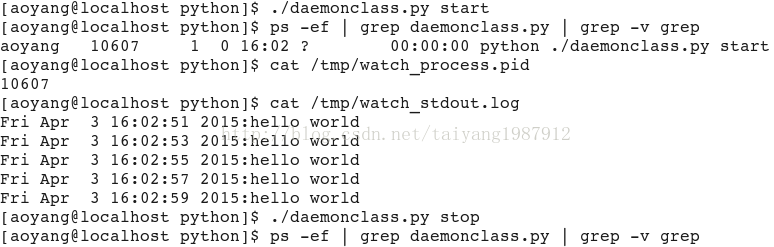
它是当Daemon设计成一个模板,在其他文件中from daemon import Daemon,然后定义子类,重写run()方法实现自己的功能。
class MyDaemon(Daemon):
  def run(self):
    while True:
      fp=open('/tmp/run.log','a+')
      fp.write('Hello World\n')
      time.sleep(1)
不足:信号处理signal.signal(signal.SIGTERM, cleanup_handler)暂时没有安装,注册程序退出时的回调函数delpid()没有被调用。
然后,再写个shell命令,加入开机启动服务,每隔2秒检测守护进程是否启动,若没有启动则启动,自动监控恢复程序。
#/bin/sh
while true
do
 count=`ps -ef | grep "daemonclass.py" | grep -v "grep"`
 if [ "$?" != "0" ]; then
   daemonclass.py start
 fi
 sleep 2
done

三、python保证只能运行一个脚本实例
1、打开文件本身加锁
#!/usr/bin/env python
#coding: utf-8
import fcntl, sys, time, os
pidfile = 0

def ApplicationInstance():
  global pidfile
  pidfile = open(os.path.realpath(__file__), "r")
  try:
    fcntl.flock(pidfile, fcntl.LOCK_EX | fcntl.LOCK_NB) #创建一个排他锁,并且所被锁住其他进程不会阻塞
  except:
    print "another instance is running..."
    sys.exit(1)

if __name__ == "__main__":
  ApplicationInstance()
  while True:
    print 'running...'
    time.sleep(1)
注意:open()参数不能使用w,否则会覆盖本身文件;pidfile必须声明为全局变量,否则局部变量生命周期结束,文件描述符会因引用计数为0被系统回收(若整个函数写在主函数中,则不需要定义成global)。

2、打开自定义文件并加锁
#!/usr/bin/env python
#coding: utf-8
import fcntl, sys, time
pidfile = 0

def ApplicationInstance():
  global pidfile
  pidfile = open("instance.pid", "w")
  try:
    fcntl.lockf(pidfile, fcntl.LOCK_EX | fcntl.LOCK_NB) #创建一个排他锁,并且所被锁住其他进程不会阻塞
  except IOError:
    print "another instance is running..."
    sys.exit(0)

if __name__ == "__main__":
  ApplicationInstance()
  while True:
    print 'running...'
    time.sleep(1)
3、检测文件中PID
#!/usr/bin/env python
#coding: utf-8
import time, os, sys
import signal

pidfile = '/tmp/process.pid'

def sig_handler(sig, frame):
  if os.path.exists(pidfile):
    os.remove(pidfile)
  sys.exit(0)

def ApplicationInstance():
  signal.signal(signal.SIGTERM, sig_handler)
  signal.signal(signal.SIGINT, sig_handler)
  signal.signal(signal.SIGQUIT, sig_handler)

  try:
   pf = file(pidfile, 'r')
   pid = int(pf.read().strip())
   pf.close()
  except IOError:
   pid = None

  if pid:
   sys.stdout.write('instance is running...\n')
   sys.exit(0)

  file(pidfile, 'w+').write('%s\n' % os.getpid())

if __name__ == "__main__":
  ApplicationInstance()
  while True:
    print 'running...'
    time.sleep(1)


4、检测特定文件夹或文件
#!/usr/bin/env python
#coding: utf-8
import time, commands, signal, sys

def sig_handler(sig, frame):
  if os.path.exists("/tmp/test"):
    os.rmdir("/tmp/test")
  sys.exit(0)

def ApplicationInstance():
  signal.signal(signal.SIGTERM, sig_handler)
  signal.signal(signal.SIGINT, sig_handler)
  signal.signal(signal.SIGQUIT, sig_handler)
  if commands.getstatusoutput("mkdir /tmp/test")[0]:
    print "instance is running..."
    sys.exit(0)

if __name__ == "__main__":
  ApplicationInstance()
  while True:
    print 'running...'
    time.sleep(1)
也可以检测某一个特定的文件,判断文件是否存在:
import os
import os.path
import time


#class used to handle one application instance mechanism
class ApplicationInstance:

  #specify the file used to save the application instance pid
  def __init__( self, pid_file ):
    self.pid_file = pid_file
    self.check()
    self.startApplication()

  #check if the current application is already running
  def check( self ):
    #check if the pidfile exists
    if not os.path.isfile( self.pid_file ):
      return
    #read the pid from the file
    pid = 0
    try:
      file = open( self.pid_file, 'rt' )
      data = file.read()
      file.close()
      pid = int( data )
    except:
      pass
    #check if the process with specified by pid exists
    if 0 == pid:
      return

    try:
      os.kill( pid, 0 )  #this will raise an exception if the pid is not valid
    except:
      return

    #exit the application
    print "The application is already running..."
    exit(0) #exit raise an exception so don't put it in a try/except block

  #called when the single instance starts to save it's pid
  def startApplication( self ):
    file = open( self.pid_file, 'wt' )
    file.write( str( os.getpid() ) )
    file.close()

  #called when the single instance exit ( remove pid file )
  def exitApplication( self ):
    try:
      os.remove( self.pid_file )
    except:
      pass


if __name__ == '__main__':
  #create application instance
  appInstance = ApplicationInstance( '/tmp/myapp.pid' )

  #do something here
  print "Start MyApp"
  time.sleep(5)  #sleep 5 seconds
  print "End MyApp"

  #remove pid file
  appInstance.exitApplication()
上述os.kill( pid, 0 )用于检测一个为pid的进程是否还活着,若该pid的进程已经停止则抛出异常,若正在运行则不发送kill信号。
5、socket监听一个特定端口
#!/usr/bin/env python
#coding: utf-8
import socket, time, sys


def ApplicationInstance():
  try:
    global s
    s = socket.socket()
    host = socket.gethostname()
    s.bind((host, 60123))
  except:
    print "instance is running..."
    sys.exit(0)

if __name__ == "__main__":
  ApplicationInstance()
  while True:
    print 'running...'
    time.sleep(1)
可以将该函数使用装饰器实现,便于重用(效果与上述相同):
#!/usr/bin/env python
#coding: utf-8
import socket, time, sys
import functools

#使用装饰器实现
def ApplicationInstance(func):
  @functools.wraps(func)
  def fun(*args,**kwargs):
    import socket
    try:
      global s
      s = socket.socket()
      host = socket.gethostname()
      s.bind((host, 60123))
    except:
      print('already has an instance...')
      return None
    return func(*args,**kwargs)
  return fun

@ApplicationInstance
def main():
  while True:
    print 'running...'
    time.sleep(1)

if __name__ == "__main__":
  main()
四、总结
(1)守护进程和单脚本运行在实际应用中比较重要,方法也比较多,可选择合适的来进行修改,可以将它们做成一个单独的类或模板,然后子类化实现自定义。
(2)daemon监控进程自动恢复避免了nohup和&的使用,并配合shell脚本可以省去很多不定时启动挂掉服务器的麻烦。
以上就是本文的全部内容,希望对大家的学习有所帮助,也希望大家多多支持PHP中文网。
更多Python守护进程和脚本单例运行详解相关文章请关注PHP中文网!